- Home
- Sacred Gallery
- SITN Government Structure
- SITN Archives
- Historical Lineage
- Ancient Knowledge
- Federal Census Records
- SITN Mission & Purpose
- Stolen Identity & Lands
- SITN Security Forces
- GEIB(Guardian Protection)
- National Funding
- Education & Science
- SITN Books
- SITN & GEIB Artifacts
- Tribal Chiefs/Ambassadors
- Tribal Citizens/Nationals
- SITN Sigils & Artifacts
- Bloodline & Ancestral
- Broken Treaties
- 509(a)(2) & 508(c)(1)(A)
- SITN-Treaty Supremacy
- Government Funding
- Purpose & Mission
- Public Notice
- Historical Continuity
- International Frameworks
- Archives & Evidence Bible
- Reclassification Erasure
- Indian Removal Act 1830
- Cultural Preservation
- Oral Traditions
- Pyramid Museums
- A Living Nation
- Principles of Governance
- Non-Corporate
- Modern infrastructure
- SITN Agriculture & Food
- SITN Infrastructure
- SITN Humanitarian Aid
- State/Federal Recognition

Welcome to Sharakhi Indigenous Tribal Nation
“SITN is a sovereign 508(c)(1)(A) tribal government—recognized by IRS and protected under United States Corporation, All 50 states, treaties, and international Indigenous law; outside agencies do not grant our existence, they only acknowledge it. ”SITN sovereign tribal lands are located in North & Central America.
Unincorporated Indigenous Tribal Government
(SITN) is a sovereign American-Indian Tribal Government

The Sharakhi Indigenous Tribal Nation (SITN) is a sovereign American-Indian government, registered with the IRS as a 508(c)(1)(A) tax-exempt tribal authority and administered through perpetual trust law.
Our mission is to preserve truth, protect ancestral identity, and steward Indigenous knowledge for future generations through lawful self-governance, humanitarian service, and peaceful nation-to-nation relations.
SITN intentionally declines federal or state “recognition” because those programs require ceding jurisdiction to outside agencies such as the Bureau of Indian Affairs. Remaining outside those gate-keeping systems safeguards our treaty rights, full sovereign immunity, and independent court, tribal police, defense security, and emergency-response structures.
Our archives, land patents, and court filings document an unbroken lineage and the lawful continuity of Sharakhi governance.
Preserving Indigenous Identity, Heritage, Culture & Historical Lineage

The Sharakhi Indigenous Tribal Nation maintains documented historical records demonstrating Indigenous continuity through lineage, geography, and lawful documentation. These records include affidavits, federal and state records, land patents, treaty references, historical hematology records, medical documentation, Indian blood and oral histories preserved within the Nation’s archives to reflect generational continuity.
Our Identity

SITN is composed of Indigenous families with documented ancestral ties in the southeastern and central regions of what is now the United States, including lineages historically identified within Creek (Muscogee), Choctaw, and Seminole contexts. The Nation’s historical record includes census documentation, family genealogies, land patent records, and treaty-era references demonstrating continuity across generations.
SITN affirms:
A living Indigenous identity, not a symbolic or revived construct
Documented lineage continuity extending over centuries
Community-based governance rooted in customary law and trust principles
A commitment to peaceful cultural preservation and lawful self-governance
Access the SITN True Hidden Identity
Historical Record & Evidence

SITN maintains a growing body of primary-source historical records, including but not limited to:
Federal and state census records
Indigenous family genealogies
Bureau of Land Management (BLM) land patent documentation
Indigenous Bloodline (Hematology records)
Treaty-era historical references
Reclassification Proof (Paper Genocide)
Birth Certificates, Death Certificates, Marriage Licenses, SSA & Military Records
Archival materials and sworn historical exhibits
These materials are preserved and presented for educational, historical, and research purposes.
Access the SITN Historical Archives
State or Federal Recognition
State or Federal Recognition
State or Federal Recognition
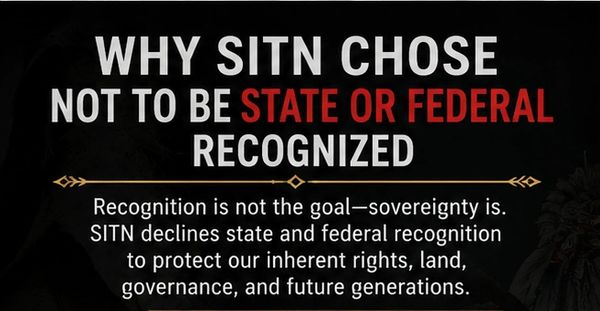
Why We Decline State & Federal Recognition
- Illinois offers no state-recognition pathway.
- Most state programs trade autonomy for full state jurisdiction.
- Federal recognition puts land in U.S. trust and subjects every decision to federal oversight.
SITN chooses true self-governance over paperwork that limits our rights.
Sovereign Recognized Nations
State or Federal Recognition
State or Federal Recognition
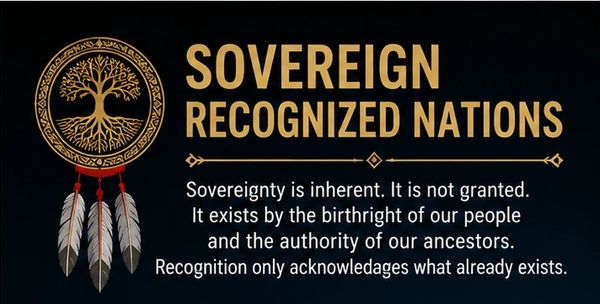
What Is a “Sovereign-Recognized” Nation?
Federal policy states that acknowledgement confirms an inherent sovereignty that already exists; it does not create or grant it.
SITN exercises that sovereignty through Tax exempt IRS Tribal Government-trust governance, customary law, treaties and nation-to-nation agreements.
Government & Governance
Tribal Governance
Tribal Governance
Tribal Governance

The Sharakhi Indigenous Tribal Nation operates under its own constitutional framework, governing bodies, and customary law. Our governance structure reflects Indigenous sovereignty, ethical leadership, and accountability to our people and future generations.
Purpose & Mission
Tribal Governance
Tribal Governance
The purpose of the Sharakhi Indigenous Tribal Nation is to preserve Indigenous identity, protect ancestral truth, and maintain lawful self-governance rooted in peace and integrity. The Nation is committed to safeguarding historical records, educating the public through verifiable sources, and stewarding cultural continuity for future generations.
Public Notice
Tribal Governance
Historical Continuity, Lineage & Treaty Foundations (Overview)
This website serves as an official informational resource of the Sharakhi Indigenous Tribal Nation. Content is provided for historical, educational, and governmental transparency purposes and is supported by documentation maintained within the Nation’s archives. This website does not solicit funds, services, or political action and is maintained solely for public record, education, and governmental transparency.
Historical Continuity, Lineage & Treaty Foundations (Overview)
Historical Continuity, Lineage & Treaty Foundations (Overview)
Historical Continuity, Lineage & Treaty Foundations (Overview)
The Sharakhi Indigenous Tribal Nation maintains documented historical records demonstrating Indigenous continuity through lineage, geography, and lawful documentation. These records include affidavits, federal and state records, land patents, treaty references, and oral histories preserved within the Nation’s archives to reflect generational continuity.
Bloodline & Ancestral Rights (Historical Context)
Historical Continuity, Lineage & Treaty Foundations (Overview)
Bloodline & Ancestral Rights (Historical Context)
SITN recognizes ancestry and kinship through documented descent, genealogy records, family records, and Indigenous customary recognition. Historical references to lineage preserved in affidavits, historical hematology records and medical documentation where applicable, oral history, and archival materials provide contextual evidence of ancestral identity and continuity across generations.es prior to forced assimilation
Land Records & BLM Documentation
Historical Continuity, Lineage & Treaty Foundations (Overview)
Bloodline & Ancestral Rights (Historical Context)
The Nation’s archives include Bureau of Land Management (BLM) land patent records and related federal documentation connected to ancestral families. These records demonstrate documented land relationships, family presence, and historical continuity recognized within official indigenous land title systems.
Foundations of Indigenous Continuity & Rights
Treaty Foundations (Historical Reference)
Treaty Foundations (Historical Reference)
The Sharakhi Indigenous Tribal Nation preserves historical references to treaties and legal instruments relevant to Indigenous peoples of the Southeast and adjoining regions. These records are maintained for historical and educational purposes and reflect documented agreements, land provisions, and legal relationships recognized during the treaty era.
International Indigenous Rights Framework
Treaty Foundations (Historical Reference)
SITN maintains references to modern international instruments recognizing Indigenous rights, including the United Nations Declaration on the Rights of Indigenous Peoples (UNDRIP). These frameworks are preserved as contextual support for principles such as self-determination, cultural preservation, and protection from forced assimilation.
Archives & Evidence Repository
The Nation maintains a historical archives repository containing affidavits, census records, land patents, treaty excerpts, and genealogical documentation. These materials are preserved as primary-source records for historical research, education, and institutional reference.
Historical Overview
Ancestral Lineage & Family Continuity
The Sharakhi Indigenous Tribal Nation represents a living continuum of Indigenous peoples whose presence and identity predate the formation of modern state and federal governments. This continuity is preserved through documented lineage, land records, oral tradition, and historical continuity maintained across generations.
Ancestral Lineage & Family Continuity
Ancestral Lineage & Family Continuity
Ancestral Lineage & Family Continuity
SITN lineage is preserved through interrelated Indigenous family lines documented across multiple generations. Family records, census documentation, land patents, and recorded settlements collectively demonstrate continuity of kinship, place, and ancestral presence tied to Indigenous homelands.
Reclassification & Historical Erasure
Ancestral Lineage & Family Continuity
Ancestral Lineage & Family Continuity
During the 18th through 20th centuries, many Indigenous families were administratively reclassified in census, tax, and property records under racial designations such as “Negro” or “Black.” These classifications were political and economic instruments of their time and do not reflect Indigenous identity, kinship, or ancestral continuity.
Indigenous Knowledge Systems: Past, Present & Future
Indian Removal Act of 1830, Trails of Tears & 1924 Racial Integrity Act

Indian Removal, Forced Migration & Racial Reclassification Federal and state policies—including forced removal, racial reclassification, and segregation-era laws—profoundly disrupted Indigenous communities during the 18th, 19th and early 20th centuries. These policies reshaped records and identities but did not erase Indigenous lineage, kinship, or continuity.
Cultural Preservation, Living Institutions & Ancient Knowledge

SITN preserves Indigenous knowledge not only through archives, but through living institutions. The Nation is developing cultural, educational, and historical centers designed to safeguard ancient wisdom while supporting future generations.
Oral Tradition & Indigenous Knowledge

Beyond written documentation, SITN preserves oral tradition as a central pillar of Indigenous continuity. Knowledge maintained by elders and family historians preserves ancestral origins, land stewardship practices, governance systems, and spiritual teachings transmitted across generations.
Pyramid Museums & Ancient Knowledge

The Sharakhi Indigenous Tribal Nation plans to establish Pyramid Museums and Knowledge Centers dedicated to preserving ancient Indigenous knowledge systems. These institutions will serve as cultural museums, archival repositories, and educational centers exploring ancient science, engineering, cosmology, and ethical technology.
Treaty & Legal-Historical Context
A Living Nation, Oriented to the Modern Tribal Future
The historical experience of SITN families is deeply connected to treaty frameworks governing Indigenous peoples of the Southeast and adjoining regions. The Nation preserves treaty references as part of its historical record to provide legal and historical context for Indigenous continuity.
A Living Nation, Oriented to the Modern Tribal Future
A Living Nation, Oriented to the Modern Tribal Future
The Sharakhi Indigenous Tribal Nation is not solely a historical entity, but a living, future-oriented Indigenous government. SITN is committed to advancing education, ethical technology, cultural preservation, and peaceful self-governance rooted in ancestral law and responsibility.
Living Governance & Indigenous Nation-Building
Principles of Governance
Non-Corporate & Non-Commercial Status
Non-Corporate & Non-Commercial Status
Governance within the Sharakhi Indigenous Tribal Nation is guided by Indigenous self-determination, peaceful coexistence, integrity, and accountability. These principles reflect ancestral law, collective responsibility, and stewardship for future generations.
Non-Corporate & Non-Commercial Status
Non-Corporate & Non-Commercial Status
Non-Corporate & Non-Commercial Status
The Sharakhi Indigenous Tribal Nation operates as a sovereign Indigenous government and does not function as a commercial or corporate entity. SITN maintains independence from corporate ownership models and does not engage in for-hire commercial services.
Artifacts & Indigenous Scholarship
Non-Corporate & Non-Commercial Status
Modern Tribal infrastructure & Economic Development
SITN museums and archives preserve historical and ancestral artifacts, restored ancient texts, and Indigenous-created works reflecting continuity of knowledge and craftsmanship. These collections support education, research, and cultural preservation.
Modern Tribal infrastructure & Economic Development
A Vision of Continuity & The Path of a Type 1 Civilization
Modern Tribal infrastructure & Economic Development
The Nation is developing modern infrastructure systems designed to support sustainable communities, ethical innovation, and economic self-sufficiency. These initiatives are rooted in stewardship, long-term planning, and Indigenous values
Advanced Education & Future-Oriented Learning
A Vision of Continuity & The Path of a Type 1 Civilization
A Vision of Continuity & The Path of a Type 1 Civilization
SITN is committed to advanced education systems integrating Indigenous history, science, engineering, ethically guided technology, and cultural law. Education initiatives are designed to prepare future generations to carry Indigenous knowledge forward responsibly.
A Vision of Continuity & The Path of a Type 1 Civilization
A Vision of Continuity & The Path of a Type 1 Civilization
A Vision of Continuity & The Path of a Type 1 Civilization
Through culture, education, and institutions, SITN affirms that Indigenous nations are contributors to humanity’s future. The Nation stands as a guardian of ancient wisdom and a steward of future knowledge.
Public Institutions & Essential Functions of the Nation
SITN Tribal Police
SITN Health, Wellness & Emergency Care
SITN Fire & Emergency Response

The SITN Tribal Police serve as the Nation’s internal public safety authority, responsible for maintaining peace, protecting community members, and upholding the Nation’s laws and public order in accordance with Indigenous governance principles.
SITN Fire & Emergency Response
SITN Health, Wellness & Emergency Care
SITN Fire & Emergency Response
The SITN Fire & Emergency Response division is dedicated to fire prevention, emergency response, and community safety preparedness. This institution exists to protect life, property, and critical infrastructure within the Nation.
SITN Health, Wellness & Emergency Care
SITN Health, Wellness & Emergency Care
SITN Health, Wellness & Emergency Care
The Nation supports health, wellness, and emergency medical response systems focused on community care, preparedness, and long-term well-being. These efforts reflect Indigenous values of balance, prevention, and collective responsibility.
SITN Humanitarian Aid & Relief
SITN National Security & Protective Institutions
SITN Health, Wellness & Emergency Care
SITN provides humanitarian assistance to communities affected by disaster, displacement, and hardship. Guided by compassion and neutrality, SITN teams deliver aid, restore dignity, and support recovery without discrimination.
SITN National Security & Protective Institutions
SITN National Security & Protective Institutions
SITN National Security & Protective Institutions
The Sharakhi Indigenous Tribal Nation maintains protective and security institutions responsible for safeguarding national integrity, public safety, and institutional continuity. These functions operate within the Nation’s lawful authority and governance framework.
SITN Environmental & Infrastructure Protection
SITN National Security & Protective Institutions
SITN National Security & Protective Institutions
SITN safeguards land, water, and critical infrastructure that sustain life and national continuity. This division protects ecosystems, preserves sacred lands, and ensures development and nature exist in balance.
National Funding Administration & Resource Development
National Funding Administration & Resource Development
National Funding Administration & Resource Development
The Nation maintains internal systems for administering public resources, grants, and development initiatives aligned with its mission and long-term planning. These processes support institutional growth, infrastructure development, and community sustainability.
🌾 SITN Agriculture & Food Security
National Funding Administration & Resource Development
National Funding Administration & Resource Development
SITN ensures food security through sustainable agriculture, land stewardship, and community-based food systems. This institution supports local farmers, protects fertile lands, and strengthens food independence for present and future generations.
SITN Education, Schools & Learning Institution
National Funding Administration & Resource Development
SITN Education, Schools & Learning Institution
SITN education institutions are dedicated to learning systems that integrate Indigenous history, culture, science, and future-oriented knowledge. Education is preserved as a cornerstone of continuity and nation-building.
Foundations of Tribal Governance, Authority & Institutional
Access & Use
Indigenous Governance Framework
Indigenous Governance Framework
The SITN Archives are provided for historical, educational, and research purposes. Certain materials may be publicly accessible, while others are preserved within controlled access repositories to protect cultural integrity and sensitive information.
Requests for archival access, citations, or research inquiries may be submitted through official SITN correspondence channels.
The Archives represent a living record and will continue to expand as additional historical materials are preserved and cataloged through Governance & Indian Tribal Government Trust Authority
Indigenous Governance Framework
Indigenous Governance Framework
Indigenous Governance Framework
The Sharakhi Indigenous Tribal Nation (SITN) operates as an 508(c)(1)(A) unincorporated Indigenous tribal government, grounded in ancestral law, tribal law, customary governance, Humanitarian, ecclesiastical, customary, sovereign, and faith-based - trust-based administration.
SITN governance exists independently of state incorporation systems and is structured to ensure continuity, accountability, and stewardship of Indigenous identity, lands, and cultural resources.
Governing Bodies
Ecclesiastical & Humanitarian
Ecclesiastical & Humanitarian
SITN governance is exercised through the following bodies:
Tribal Council — Responsible for policy guidance, governance decisions, and community oversight
Council of Elders — Custodians of oral history, cultural law, and ancestral knowledge
Trust Administration — Fiduciary stewardship of cultural, historical, and community assets
These bodies function collectively to preserve Indigenous governance traditions while maintaining modern administrative clarity.
Ecclesiastical & Humanitarian
Ecclesiastical & Humanitarian
Ecclesiastical & Humanitarian
SITN utilizes trust-based governance structures to protect cultural property, historical records, land interests, and institutional initiatives. Trust administration ensures:
Tribal Government 508(c)(1)(A) Faith-Based-Trust Authority
Ecclesiastical & Humanitarian
Non-commercial stewardship
Protection from improper alienation or exploitation
Continuity across generations
Trust instruments are maintained as part of the Nation’s foundational records.
SITN Sacred Books
Available through major book retailers and online platforms

SITN books on historical lineage, ancient knowledge and visions of the future are available